Wednesday, July 6, 2016

A Day at the Beach

A Day at the Beach by Mircea Vasiliu (Random House, 1978).

Seeing as it's 90 degrees here, I thought this book was appropriate for today.  It's a simple story showing a family at the beach: swimming, building sandcastles, exploring tide pools, collecting shells, playing in seaweed. A nice feature is that there is a picture glossary with the names of different types of wildlife at the beach. There is also some diversity in the crowd scenes. All in all, a nice little book for summer.


Sunday, June 26, 2016

Moonshadow

Sorry it's been a while since my last post. I recently got a new job and moved back to my hometown in Connecticut so I've been busy, but it's also easier now for me to raid my parents' attic for my old childhood books.  

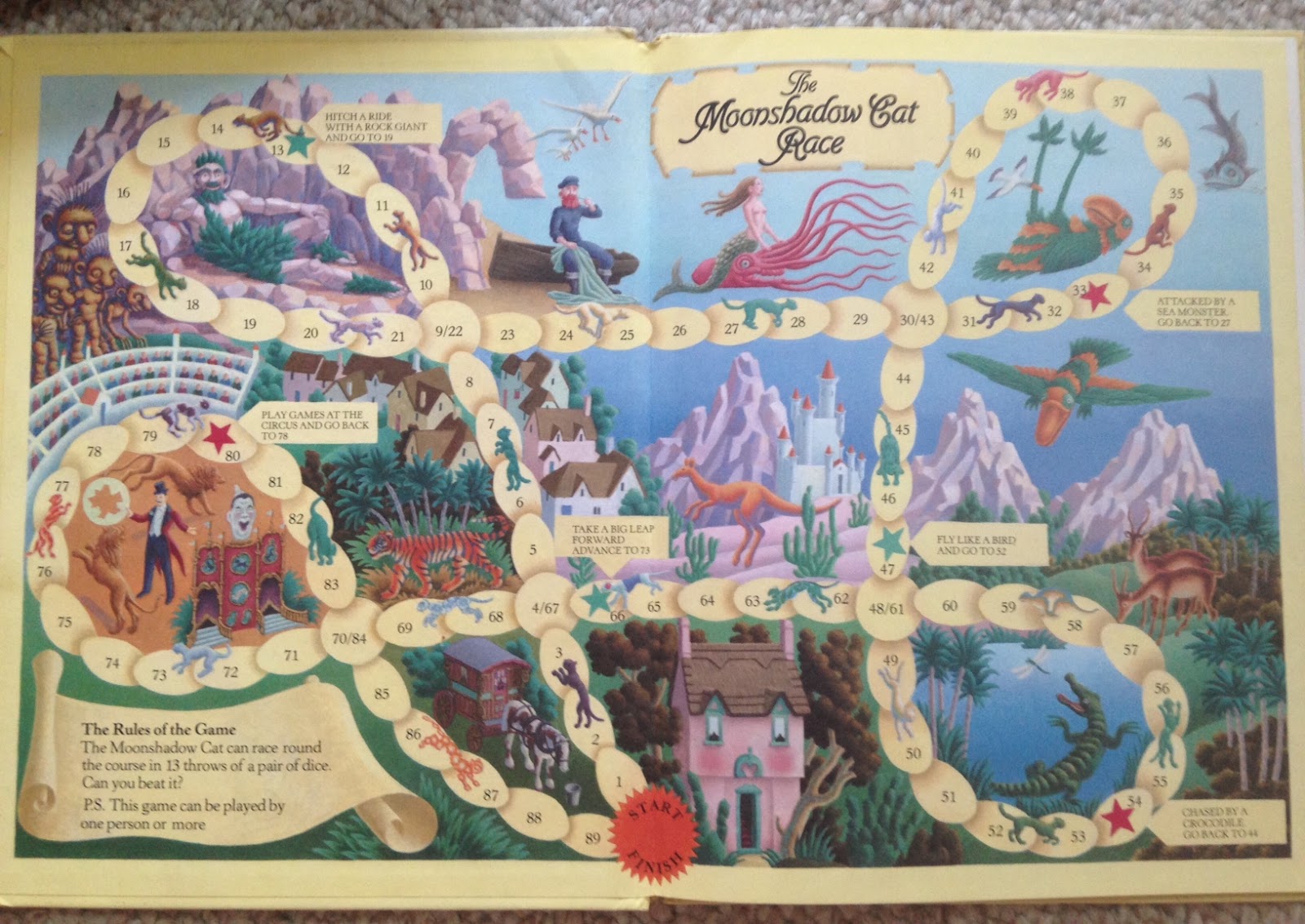
Moonshadow by Angela Carter, illustrated by Justin Todd (Victor Gollancz Ltd., 1982).

Apparently a rather rare book, this was one of my favorites as a kid.  My dad and I found it at a used bookstore when I was little and I loved the way he would read me the zany story and we would find the hidden pictures within the illustrations. 


The book is about a boy named Tom who likes to play with his shadow, casting shadow puppets on the wall before bed.  One night, a goblin, who says he's the Man in the Moon, jumps out at Tom and tells him his shadow is tired of him playing games with him and wants a night of freedom where he doesn't have to follow him around all the time.  Off his shadow goes, in the shape of a cat, and Tom must run to catch him.  The illustrations feature many optical illusions and hidden pictures.  In the beginning there is also a map for a board game that you can play with dice. 

In researching the author and illustrator, I discovered that they are both relatively well known in Britain.  Carter is known for her feminist and magical realism novels and Todd seems to be best known for illustrating British children's classics like Alice in Wonderland and The Wind in the Willows. 


This is definitely a unique children's book! Maybe a little too scary for some young kids, but it was enchanting for me.

Thursday, March 24, 2016

Easter Surprise

Easter Surprise by Catherine Stock (Bradbury, 1991).

This is a sweet story that follows a brother and sister with their mother on Easter.  I always love Stock's watercolor illustrations and her style works perfectly for the story. 


For more Easter children's books, visit my Pinterest here.

Tuesday, March 15, 2016

This is Ireland

This is Ireland by Miroslav Sasek (Universe, 2005). 


With St. Patrick's Day coming up, I thought it would be fun to take a look at this book. This is a reprint of Sasek's original book in the 1960s.  The vintage drawings are fun, but what's interesting is how current the images are in many ways.  I did an Irish study abroad program in college back in summer 2007 so it was fun seeing a lot of the landmarks I saw then.

Below are the famous Cliffs of Moher, both the illustration and a photo I took.


Lough Leane in Killarney 


The colorful houses of Dublin


I hope everyone has a fun St. Patrick's Day!  

For more Irish children's books, check out my Pinterest board.

Tuesday, March 8, 2016

Bunnies and Baskets and Eggs

Guest post by Charlotte Riggle, author of Catherine’s Pascha: A Celebration of Easter in the Orthodox Church (Phoenix Flair Press, 2015).

If you look at a collection of children’s Easter books, you can’t help but wonder: How did Easter become associated with bunnies and baskets and eggs?

Easter Bunnies

Let’s start with the bunnies. We know that Easter baskets and Easter eggs are very, very old. The Easter bunny is a much newer tradition. It seems to have appeared in the early years of the Protestant Reformation. During times of anti-Catholic fervor, traditions and stories that were associated with the older, Catholic celebrations were suppressed. If a tradition was to be kept, a new story had to be created.

And that’s just what happened. The Easter hare first showed up among Lutherans in Germany in the sixteenth century. The hare decided which children had been naughty and which had been nice, and the nice children received fancy colored eggs on Easter morning.

From there, the Easter hare traveled west to America with German immigrants. Once it arrived, it changed to a rabbit, because the cottontail rabbit was common in America, and hares were not.

The story didn’t travel east to countries that weren’t affected by the Reformation. Those countries kept the old traditions and the old stories.

Easter Eggs

So, if the story about Easter bunnies bringing eggs is a new story, what were the old stories?

My favorite of the old stories tells about Mary Magdalene’s trip to Rome, shortly after the very first Easter morning. While in Rome, she arranged an audience with the Emperor Tiberius. She told the Emperor about Jesus, about his death and resurrection. As she spoke, she picked up an egg from the table. Perhaps she used it to illustrate the stone that had sealed the tomb. Perhaps she was just fidgeting.

Whatever the reason, Tiberius grew tired of her story, and shouted, “A man can’t come back from the dead any more than that egg in your hand can turn blood-red!” As he spoke these words, the egg in Mary’s hand changed from white to red. Mary, astonished, held the egg up for all to see, saying, “Christ is risen from the dead!”

And so, in honor of Mary Magdalene, and in honor of the Resurrection, Christians have dyed eggs red at Easter ever since.

Of course, throughout America, you’re more likely to see eggs dyed in pastels, or with stripes or polka dots, than red eggs. But if you go to an Orthodox Church on Pascha (which is the name that Orthodox Christians use for Easter), you’ll likely see baskets full of red eggs.

Easter Baskets

What do those baskets full of red eggs have to do with baskets of eggs and candy and toys that we give children on Easter morning?

Among the early Christians, it was customary to take baskets of food to church on the most important feast days. The baskets would be blessed, and the food shared. On the feast of the Transfiguration in August, for example, people brought baskets of fruit. At Pascha (which is what the early Christians called Easter), people brought baskets loaded with meat and cheese and eggs. These were the foods that they had fasted from for all of Lent.

The custom of bringing baskets of food to church on Pascha was mostly lost in Greece during the four centuries of Turkish rule. The practice survived only in a few villages in northern Greece and in the Peloponnesus region.

In England and America, the custom was lost in the seventeenth century, when the celebration of Easter and other holy days was banned. But, as in Greece, the custom did not disappear entirely. When the holy days were restored, Easter baskets returned. But as the hare had changed to a bunny, the big baskets full of meat and cheese changed to small baskets filled with sweets for children.

The ancient practice lived on in Slavic countries. In Russia, Ukraine, Poland, and at many Orthodox churches in America, wicker baskets are loaded with rich foods and meats, decorated with bows and flowers, and covered with embroidered cloths. These baskets are brought to church before the midnight service of Easter begins, and they’re blessed at the end of the services.

Things to Read and Things to Do


It’s easy and fun to make red Easter eggs. The natural red dye is made from the papery brown skins of yellow onions.

Learn more about the tradition of making embroidered Pascha basket covers. Your children can make simple cloth covers for their Easter baskets. And if you’re handy with a needle, you can make a Pascha basket cover using one of these patterns. If you don’t need to cover a Pascha basket, you can frame your work and hang it on the wall.

Share Catherine’s Pascha with your children. The story follows a sleepy young girl as she attends the Orthodox Easter service in the middle of the night. Can she stay awake all night? Will her parents let her play with burning candles? Will she catch someone’s hair on fire? Who will win the egg-banging contest?

Friday, February 19, 2016

Where is Simon, Sandy? The Story of a Little Donkey That Wouldn't Quit

Where is Simon, Sandy? The Story of a Little Donkey That Wouldn't Quit by Donna Marie Seim, illustrated by Susan Spellman (PublishingWorks, 2008).

Based on a folktale from the Turks and Caicos, this is a story about a man named Simon who delivers water with his donkey Sandy everyday.  When Simon falls ill, it's up to Sandy to save the day.  The illustrations really capture the beauty of the Caribbean. 


Sunday, February 14, 2016

Happy Valentine's Day!

from Rhyme Time Valentine by Nancy Poydar (Holiday House, 2002)


I was honored to be invited to write a guest post at Catherine's Pascha blog about diversity in Valentine's Day children's books.  You can read it here.